
Hi Gilad,
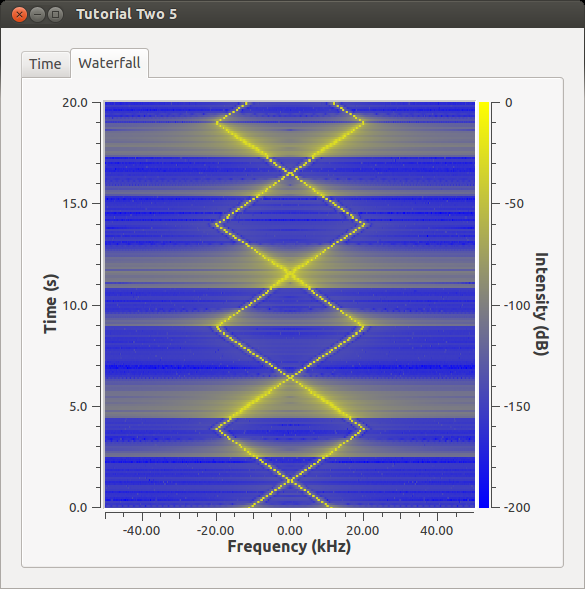
find something that actually produces a singing sine attached. Notice that the waterfall sink display isn't "perfect" by means of being a constant-height zig-zag line. But that was never to be expected – the DFT simply produces higher amplitudes at frequencies that are actually exactly "hit" by the signal, and since the signal frequency changes continously, this can't be always the case.
I don't think I can salvage the example – it's really an illustration of what not to do with a signal probe; if you want one signal to somehow modulate the other, you'd always (and that's the whole idea behind GR) combine the two sample streams, and not employ some inaccurate, hackish python-function-probing mechanism. So please don't take the example from the wiki as guideline for building modulators!
Marcus
Hi Gilad,
yes, that's now my new not-favourite example, because it uses a signal probe where it shouldn't be using a signal probe. You're right, this *cannot* work reliably. (to explain: GNU Radio blocks always run as fast as possible. For example, the the signal probe just drops the signal as fast as possible, but "writes down" the last value every iteration; thus, the triangle-generating signal source runs as fast as it can, and probably produces 10s of millions of samples per second. Thus, the value seen by the function probe every roughly so and so many milliseconds is absolutely random. I wonder under which conditions this flowgraph used to work; in theory, we've tested them all :) ooops)
I'll fix the example and let you know as soon as I have something better for you :)
Best regards,
Marcus
On 14.11.2016 06:03, Gilad Beeri (ApolloShield) wrote:
Hi,Going over tutorial 2 http://gnuradio.org/redmine/projects/gnuradio/wiki/Guided_Tutorial_GRC,trying the last example (a triangle wave, prove signal and a sine wave), which based on common sense and the image in the tutorial, should result in a periodic triangle shape in the waterfall scope.
I get a completely different result, see image attached.My flowgraph seems to be accurate, also when running tutorial_two_7.grc from the examples I get the same result.
GNU Radio 3.7.10.1, mac OS 10.12.1.
Do you have an idea why I don't get the expected shape?
This is the image from the tutorial: https://raw.githubusercontent.com/gnuradio/gr-tutorial/master/examples/tutorial2/images/singing_waterfall.png
This is what I get (when running the example, not my own flowgraph):
_______________________________________________ Discuss-gnuradio mailing list Discuss-gnuradio@gnu.org https://lists.gnu.org/mailman/listinfo/discuss-gnuradio


No comments:
Post a Comment