> On Fri, 2011-01-28 at 02:09 -0500, Sangho Oh wrote:
>> Hello, I am transmitting 20Mhz OFDM symbols using UHD code.
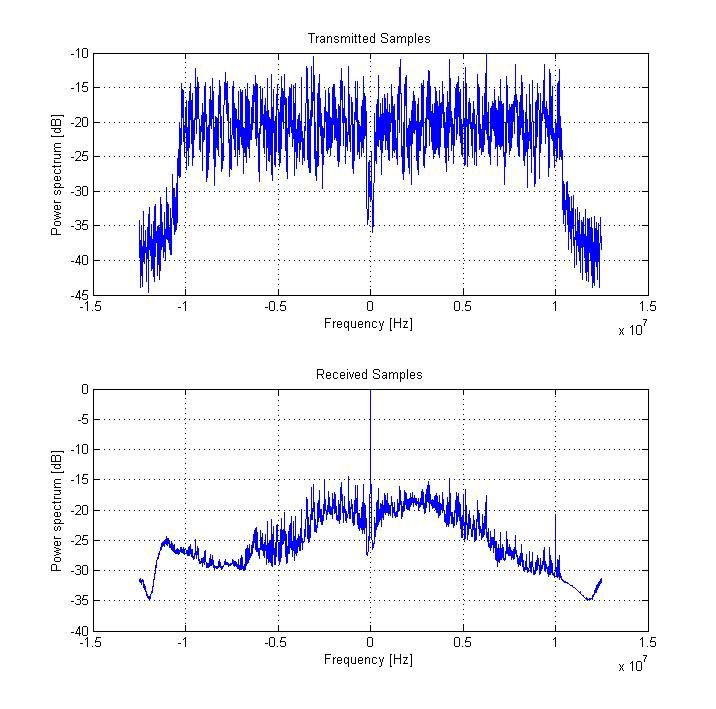
>> When I checked the PSD of the received samples using UHD
>> (rx_samples_to_file)
>> I found there is a significant difference in PSD between the
>> transmitted and received signal.
>>
>>
>> Reception decimation is 4 and I used re-sampled data (4/5) for OFDM
>> demodulation.
>> Here is the figure showing the PDS difference.
>>
>>
>> http://i1181.photobucket.com/albums/x423/notilas/untitled.jpg
>>
>>
>> Someone guessed that this is a natural thing related to the low pass
>> filter in RF parts of Gnuradio.
>> However, I would like to ask valuable comments from radio experts.
>>
>
>
> The spectrum looks very strange so I would guess saturation or
> something.
Yes, it does look very saturated. Remember, OFDM has a very high peak
to average ratio.
>
> However, I have had some experiences I would like to discuss. I have
> experimented with OFDM waveforms on USRP1, USRP2 and also another
> home-brewed testbed. What I generally find is that an oversampling of a
> factor of two is required. Thus with 25MHz sample-rate I can squeeze in
> a maximum 12.5MHz signal. I can use more but at the expense of much
> worse performance. I think the main problem is nonlinearities. The
> nonlinearities causes intermods. If the sampling frequency is less than
> twice the bandwidth, 3rd order intermods will fold into the desired
> signal.
Intermod is not affected by sample rate because intermod only happens on
analog signals (assuming you don't have digital clipping), and the
signals are only converted to/from analog at the maximum sample rate.
What you may be seeing is aliasing, which will be noticeable when you
try to make your signal wider than 75% of the sample rate.
Matt
_______________________________________________
Discuss-gnuradio mailing list
Discuss-gnuradio@gnu.org
http://lists.gnu.org/mailman/listinfo/discuss-gnuradio

No comments:
Post a Comment